Closing a Mining Month: Booking the Listed Fee as a Cost Centre
At 1,996 TH/s the month's gross mining revenue is 0.0268626 BTC, or $2,274.90 at $84,692. The listed 4% on the block-reward component removes about $91.00, leaving $2,183.90 in the wallet. Booking those as three lines instead of one is what makes the month auditable.

Key takeaways
- Thirty days at 1,996 TH/s produce $2,274.90 gross and $2,183.90 net at today's inputs.
- The listed fee is a cost of revenue, not a rounding adjustment to be absorbed silently.
- Reconcile the wallet credits against the statement before closing the period.
- Keep the gross line even though it never reaches the wallet; comparisons depend on it.
One deposit, three numbers
The wallet shows a single credit. Behind it sit gross revenue, a listed charge and a net figure, and only the net one is spendable. An operator who records just the deposit has no way to see whether the charge moved, whether a scheme change helped, or whether a month's income was unusually high because of fees rather than hashrate.
Splitting the deposit into its parts costs a few minutes a month and pays for itself the first time somebody asks a question. A lender, an accountant or a partner will want to know revenue before charges; a wallet export will not answer that, because the charge was deducted upstream and never appeared as a transaction.
Why the charge gets its own line
Grouping the fee with power and hosting hides what kind of cost it is. Power varies with the machines and the tariff. Hosting varies with the contract. The pool charge varies with gross income, which makes it a percentage cost of revenue rather than a fixed overhead. Booking it separately keeps that behaviour visible when the lines are compared month to month.
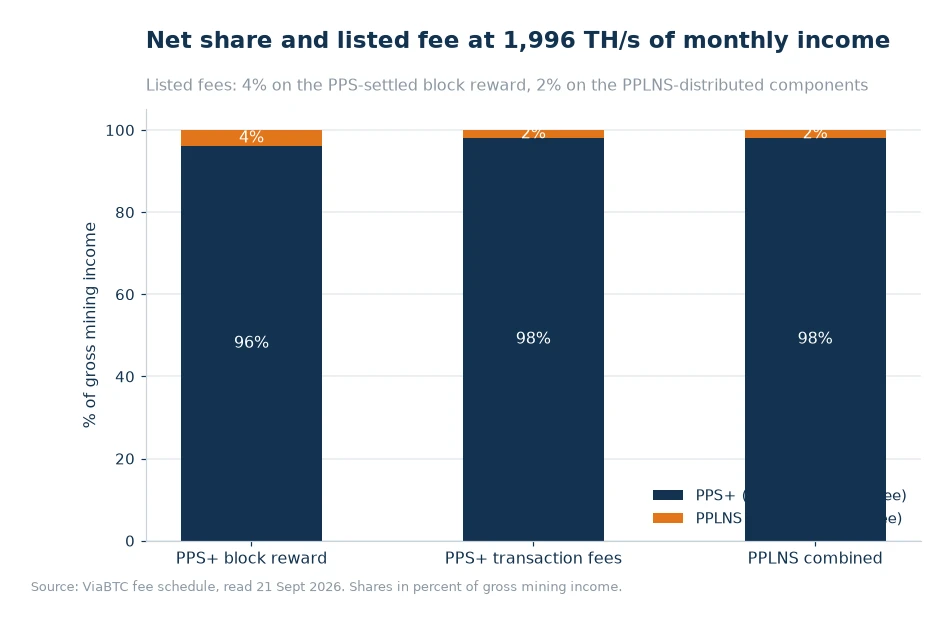
The line also depends on the scheme. Under PPS+, the statement carries a 4% charge on the subsidy slice and a 2% charge on the fee slice, so two sub-lines are needed for a clean close. Under PPLNS, a single 2% applies to the combined figure. Pick the structure that matches the account and keep it for the year, because changing the chart of accounts mid-year makes every comparison harder.
Reconciling the wallet to the statement
Start with the pool's own figures for the period: gross income, the charge, and the net credit. Then open the wallet and list every incoming mining credit with its timestamp. The two totals should agree to within rounding. Where they do not, the usual causes are a credit that landed just after midnight, a difficulty change inside the window, or a unit that was offline for part of the period.
Do the comparison in bitcoin first, then convert at a single rate for the period. Converting each credit at its own day's price produces a dollar total that nobody can reproduce later, and the difference will look like an error even when the coin count is exact. One rate, stated on the summary, is easier to defend and easier to audit.
When the totals disagree
Small differences are normal and should be written down rather than chased. A gap under a tenth of a percent is almost always rounding or a timestamp at the boundary. A gap of several percent is worth investigating, and the first question is always whether the hashrate was actually delivered for the full period.
Check the worker list for gaps, then check whether the machines were throttled during a hot spell. A unit running below its rated hashrate still produces credits, just fewer, and the statement will be internally consistent while the revenue line is lower than planned. That is an operations finding, not an accounting one, and it belongs in the same monthly note.
Where the charge is disclosed
The ViaBTC Pool Fees page is the source for both listed rates and for which component each one applies to. The monthly statement is the source for what was actually charged. Keep the two side by side at close, because the schedule explains the rule while the statement shows the application, and only the pair together can tell you whether the charge is correct.
Print or save the schedule once a quarter and write the read date on it. Fee structures and settlement rules are the kind of thing that gets updated quietly, and a twelve-month review built on an old printout will misattribute a change in the charge to a change in income. The date on the page is part of the record, not decoration.
This is also the document to open when a statement line looks unfamiliar. Most surprises turn out to be a component the operator had not separated before, such as the fee-slice charge arriving on a different rhythm from the hourly subsidy credit. Reading the rule first saves a support ticket and, more usefully, saves the operator from booking the difference in the wrong place.
What the close should produce
Four outputs: the gross revenue in BTC and dollars, the listed charge in both, the net credit, and a one-line note on anything unusual. That is enough for a tax preparer, a lender reviewing a loan application, or an owner comparing this month with the last twelve. It is also short enough that it actually gets done.
Keep the source documents with it: the statement export, the wallet export and the difficulty reading for the period. A close that cannot be reconstructed from its own attachments is a summary, not a record, and summaries tend to acquire convenient omissions over time.
| Line | USD for 30 days | BTC for 30 days |
|---|---|---|
| Gross mining revenue | $2,274.90 | 0.0268626 |
| Listed 4% on block-reward component | $91.00 | 0.0010745 |
| Net credit to wallet | $2,183.90 | 0.0257881 |
| Memo: listed 2% on a combined base | $45.50 | 0.0005373 |
Worked example
Build one day, then multiply it into the month and check both charges.
- A day of blocks: 144 × 3.125 = 450 BTC of new supply.
- Per terahash: 450 ÷ 1,003,000,000 = 0.00000044865 BTC.
- 1,996 TH/s × 0.00000044865 = 0.00089542 BTC a day.
- At $84,692: 0.00089542 × 84,692 = $75.83.
- Listed 4% on the block-reward base: 75.83 × 0.04 = $3.03 a day.
- Thirty days: gross $2,274.90, charge $91.00, net $2,183.90.
- In coins: 0.00089542 × 30 = 0.0268626 BTC gross, and 0.0268626 × 0.04 = 0.0010745 BTC for the charge.
- The listed 2% on a combined base would be $45.50 a month, which is the memo line and not what a PPS+ account pays.
Frequently asked questions
Should the listed fee be recorded as an expense?
Record it as a deduction from mining revenue, with the gross revenue shown above it. That keeps the percentage relationship visible and lets a reader see both the income the hardware generated and the charge applied to it.
Which exchange rate should the month use?
One rate for the whole period, stated on the summary. Using each day's rate makes the dollar total impossible to reproduce and turns normal price movement into an apparent reconciliation error.
How large a difference is acceptable at close?
Under 0.1% is rounding and timestamps. A larger gap should trigger a check of delivered hashrate for the period before any adjustment is booked, since downtime is the most common cause.
Close it in twenty minutes
Export the statement, export the wallet, apply one rate, and write the four lines. The multi-currency wallet gives the credit side, and the Profit Calculator gives a cross-check on gross at the period's difficulty. If the three agree, the month is done.
Do it on the same date every month, and keep the files together. Twelve clean closes are worth more than a perfect spreadsheet built once in April and abandoned by June, and they make the annual review a matter of addition rather than archaeology.
Sources: ViaBTC fee schedule, wallet and calculator pages for rates and credit records[1]. Figures read 21 Sept 2026: 1,003 EH/s hashrate, 132.76 T difficulty, 144 blocks of 3.125 BTC a day, BTC $84,692. Published 24 Oct 2026; the month is 30 days at constant conditions.