RTA Cabinet Boxes: Plywood, Dovetail and Soft-Close
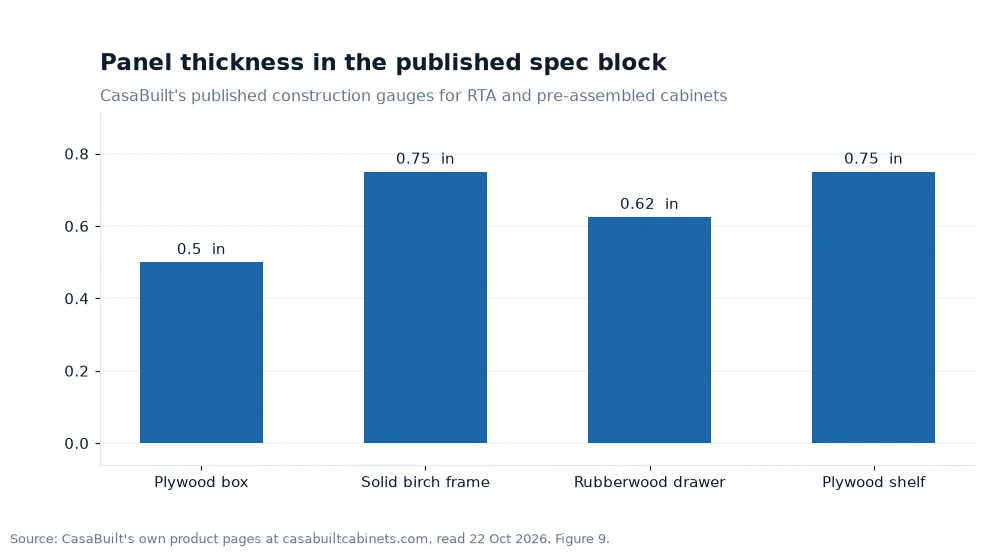
The box is the part of a cabinet nobody photographs and the part that decides whether the doors still line up after five years of use. CasaBuilt publishes four gauges that describe it: a 1/2-inch plywood box, a 3/4-inch solid birch face frame, 5/8-inch rubberwood drawer sides and a 3/4-inch plywood shelf. Read together, they explain how the cabinet carries load, where it flexes and why the door closes quietly.
Key takeaways
- The box is 1/2-inch birch plywood; the face frame is 3/4-inch solid birch.
- Drawer sides are 5/8-inch rubberwood with dovetail joints.
- Shelves are 3/4-inch adjustable plywood, with a half-depth shelf in base cabinets.
- Hinges and glides are soft-close, and the finish is seven coats of paint with a UV layer.
The box is the part that fails first
A cabinet fails in three ways: the box racks out of square, the shelves sag, or the hardware pulls loose from the panel it was screwed into. All three are construction failures, and all three are decided before the door is hung. A door that will not close is usually a symptom of a box that has moved, not a hinge that has worn out.
Plywood is used for the box because it carries load in two directions at once. A solid panel of the same thickness moves with humidity across its width; a plywood panel resists that movement because the plies alternate direction. That is why the published box is 1/2-inch birch plywood with a natural birch interior rather than a single board. The face frame is solid birch, 3/4-inch by 1-1/2-inch, because it takes screws and hinges at the edge where plywood would split.
The combination is a cheap-to-describe, expensive-to-copy structure. A buyer comparing boxes should ask for panel thickness, core material and face-frame dimensions, then compare those three lines before comparing price.
Racking is the failure mode worth understanding before the cabinets arrive. A box goes out of square when the back, the sides and the bottom are not joined in the same plane, and the symptom appears at the front: one door overlaps its neighbor at the top, another at the bottom, and the gaps change as the cabinet is loaded. A square carcass with a stiff face frame resists that movement because the frame ties the front edges together. A cabinet assembled on an uneven floor and then dragged into place can be perfectly square on the bench and out of square on the wall, which is why installation starts with a level line rather than with the first screw.
Four gauges in the published spec block
The construction block published with the rta cabinets range gives a thickness for each component, and each thickness answers a different structural question. The table also lists the substitute a cheaper cabinet is likely to use, because that is the comparison a buyer actually faces.
| Component | Published value | Likely substitute | What to check on delivery |
|---|---|---|---|
| Plywood box | 1/2 inch birch plywood | Thinner panel or furniture board | Edge grain shows layered plies |
| Solid birch frame | 3/4 inch by 1-1/2 inch | Plywood strip or applied moulding | Frame takes a screw without splitting |
| Rubberwood drawer | 5/8 inch, dovetail joints | Stapled or dowelled box | Interlocking pins at the corners |
| Plywood shelf | 3/4 inch, adjustable | Thinner shelf with a front rail | Shelf spans the full interior depth |
None of these checks requires a moisture meter or a lab. They require a flashlight and a look at an edge. A plywood edge shows stripes. A dovetail corner shows interlocking teeth. A solid frame shows end grain where it meets the box.
Dovetail drawers and the 5/8-inch side
Drawer sides are listed at 5/8-inch rubberwood with dovetail joints. Rubberwood is a dense, close-grained hardwood that holds a machined joint well; the dovetail is the joint itself, with angled pins and tails that resist pulling apart under load. A stapled box relies on the staples; a dovetail box relies on the geometry.
The 5/8-inch side is a middle gauge, thicker than the box and thinner than the shelf. That is the right compromise for a drawer: the side has to carry the contents and take the glide mounting screws, but it also has to keep the drawer light enough to slide easily on a full-extension glide. The published glides are soft-close undermount with full extension, which means the drawer box sits on runners under the base rather than hanging from the sides.
Undermount glides are less forgiving of a drawer box that is not square. That is why the drawer is a good place to inspect a delivered cabinet: if the drawer closes flush and stays flush, the box is probably square.
Soft-close hardware and the finish on top
The hinges are concealed, soft-close and six-way adjustable. Six-way adjustment means the door can move up, down, left, right, in and out after it is hung, which is how a run of doors is brought into a consistent reveal without moving the cabinets. Soft-close is a small piston in the hinge that catches the door in the last few degrees and pulls it shut.
The finish is seven coats of paint with a UV protective layer. Coats matter because each one is a separate pass with a sand between, and the UV layer matters because a white or pale door in a sunlit kitchen will change color without it. The published warranty is one year against manufacturing defects in materials and workmanship under normal residential use, with a replacement part or an agreed solution as the remedy; details sit on the warranty policy page.
Hardware and finish are the two lines a buyer can evaluate without opening a cabinet. Ask what the hinge adjustment range is and how many coats are on the door. A seller who cannot answer either question has not published the spec.
Worked example: what the thickness differences mean
The chart lists four values in inches: plywood box 0.5, solid birch frame 0.75, rubberwood drawer 0.625 and plywood shelf 0.75. Compare the frame to the box: 0.75 divided by 0.5 is 1.5, so the face frame is 50% thicker than the panel it is attached to. Compare the drawer side to the shelf: 0.625 divided by 0.75 is 0.833, so the drawer side is 83.3% of the shelf thickness, a difference of 0.125 inch, or one eighth.
Now apply the box gauge to a real cabinet. A 24-inch-deep base with a 1/2-inch panel on each side leaves 24 minus two times 0.5, or 23 inches of interior depth. The 3/4-inch shelf spans those 23 inches, so its span-to-thickness ratio is 23 divided by 0.75, or about 30.7 to 1. A shelf at half that thickness would be at roughly 61 to 1, which is where sag begins under a load of plates.
The four gauges also sum to 0.5 plus 0.75 plus 0.625 plus 0.75, or 2.625 inches. That number has no direct use in a kitchen, but it is a quick way to check a spec sheet that claims one thickness for everything: a single number across four components means at least three of them are wrong.
Frequently asked questions
Is a 1/2-inch plywood box strong enough for a kitchen?
Half-inch birch plywood is the published box material, and plywood carries load across its face rather than relying on thickness alone. The 3/4-inch solid birch face frame stiffens the front edge and takes the hinge screws. Strength in a cabinet comes from that combination plus a square assembly, not from the box panel in isolation.
What does a dovetail drawer joint actually do?
A dovetail joint uses angled pins and tails that lock together, so the drawer resists being pulled apart at the corners. The published drawer sides are 5/8-inch rubberwood with dovetail joints. It is a construction detail you can see at the corner of an open drawer, and it is one of the few spec lines a buyer can verify without tools.
Are the hinges and glides really soft-close?
Yes, both are published as soft-close: concealed hinges with six-way adjustment and undermount drawer glides with full extension. Soft-close means the last part of the travel is damped rather than free. Check it on delivery by pushing a door and a drawer closed from a few inches open and listening for the catch.
Ask for the spec sheet, then read the edges
Before ordering, request the construction lines in writing: box material and thickness, face-frame dimensions, drawer material and joint, shelf thickness, hinge adjustment and glide type. Six lines cover almost everything that will matter in year five. Then compare them with any competing quote on the same six lines.
At delivery, open one cabinet and look at an edge. Plywood shows its plies, a dovetail shows its teeth, and a solid frame shows end grain. The box is the part nobody photographs, which is exactly why it is the part worth inspecting.
Figures quoted here come from the manufacturer's own website, read 22 Oct 2026[1].