Beer Kit From 1 to 100 Barrels
Barrels are a poor unit for buyers who think in litres and a hard limit for buyers who do not, because the two scales rarely appear together. HGMC publishes brewery equipment from 1 BBL to 100 BBL on a site that also quotes capacities from 100 L to 200 T, and 1 BBL is about 117 litres. That single conversion turns the whole range into something you can compare against a lease, a boiler and a cellar.
Key takeaways
- The published equipment range runs from 1 BBL to 100 BBL, and 1 BBL is about 117 litres.
- Nano sets sit at 5 BBL or less; micro craft systems run from 1,000 L to 3,000 L.
- Large commercial designs are published up to 100 HL, which is 10,000 litres.
- HGMC states its products are exported to more than 120 countries and works in compliance with the ISO9001:2015 quality management system.
What a barrel means in litres
A US beer barrel is 31 US gallons, which is about 117 litres. A hectolitre is 100 litres, so one barrel is roughly 1.17 hectolitres and ten barrels is roughly 11.7 hectolitres. Those two conversions do most of the work when a specification arrives in one unit and your tank farm is planned in the other.
Working at the round numbers avoids most of the argument: 5 BBL is about 585 litres, 10 BBL about 1,174 litres, 20 BBL about 2,340 litres and 100 BBL about 11,700 litres. The HGMC brewery site uses 1,174 litres as its own figure for a 10 BBL system, which is the number to keep if you want your arithmetic to match theirs.
The two ends of the published range
For anyone compiling a short list of Beer Brewing Equipment Manufacturers, the useful question is where the published range actually stops at each end. At the small end, HGMC describes a nano brewery as 5 BBL or less and notes that it takes little space, which makes it a taproom or restaurant installation rather than a production plant. At the other end, the large commercial page publishes equipment up to 100 HL and lists hot products in the 20 T to 50 T band alongside systems of 5 BBL to 20 BBL. Those two sentences cover a range of roughly one hundred to one in batch size.
In the middle sits the micro craft bracket, published as 1,000 L to 3,000 L, which is about 8.5 BBL to 26 BBL. The company defines microbrewery equipment as plant producing 18,000 barrels or less a year, a definition that makes the middle of the range look far larger than most taproom brewers expect.
Where the litre bands and the barrel bands meet
The published litre figures and the published barrel figures describe the same machines from two directions. A 1,000 L brewhouse is an 8.5 BBL brewhouse; a 3,000 L system is about 25.6 BBL. Read the other way, a 20 BBL system is about 2,340 litres, which lands inside the micro craft bracket that HGMC publishes in litres.
This duality is useful at the specification stage. Contracts in the United States tend to arrive in barrels, equipment drawings in Europe tend to arrive in hectolitres, and fermentation scheduling tends to happen in litres per tank. A supplier who can quote in all three from the same underlying vessel size saves a buyer from making conversion errors in the one document that matters.
Fabrication details that repeat across the range
HGMC publishes the same construction story at every size: TIG 100% full welding joints, polishing accuracy of ≤0.4 μm on the wetted surfaces, and stainless steel 304 or 316 with plate thicknesses of 3 mm and 2 mm. The vessels use SUS304 food-grade material certified by SGS. None of those details change between a 5 BBL nano set and a 100 BBL plant, which is a large part of why a small system does not feel like a scaled-down compromise.
The brewing side carries the same consistency. Published design points include automatic temperature control across mash, wort and water, a steam system designed as a whole rather than assembled from parts, jackets on both the body and the cone, and a piping layout intended to avoid wort aeration. The site also states that the equipment can handle beer up to 33 Plato, which covers the strong end of most brewery portfolios.
The published range in one table
| Published size | Approx. litres | Class on the site |
|---|---|---|
| 1 BBL | About 117 L | Bottom of the published equipment range |
| 5 BBL | About 585 L | Nano brewery, published as 5 BBL or less |
| 10 BBL | About 1,174 L | The system used in the site's own cost example |
| 20 BBL | About 2,340 L | Inside the published 5 BBL–20 BBL hot product band |
| 100 BBL | About 11,700 L | Top of the equipment range; large commercial designs quoted to 100 HL |
Worked example: cost per litre and per barrel at 10 BBL
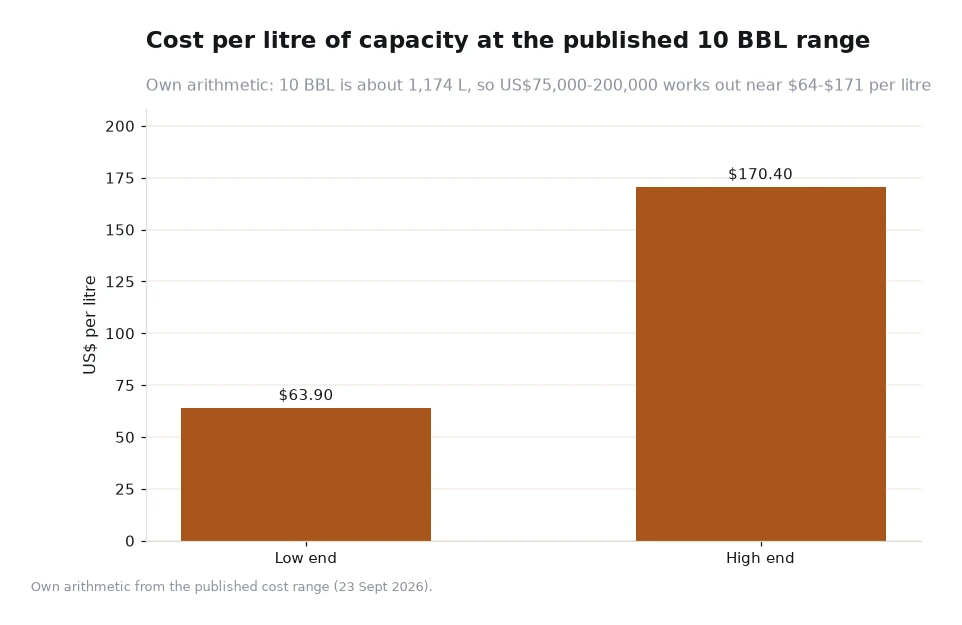
HGMC publishes a complete 10 BBL beer equipment system at around US$75,000–200,000, with a note that valves, pipes, steam boiler and other requirements move the figure. Using the same site's conversion of 10 BBL to about 1,174 litres, the low end works out at US$75,000 ÷ 1,174 = US$63.9 per litre of installed capacity, and the high end at US$200,000 ÷ 1,174 = US$170.4 per litre.
Output gives the second view. Assume ten barrels a brew and eight brews a month: 10 × 8 = 80 BBL a month, and 80 × 12 = 960 BBL a year. Dividing the low-end figure by that annual capacity gives US$75,000 ÷ 960 = US$78.1 per barrel of yearly capacity, against US$200,000 ÷ 960 = US$208.3 at the high end. Both results are arithmetic on published numbers with the assumptions stated, not a quotation for any particular order.
The gap between the two ends is where the specification lives. A system ordered with a steam boiler, a fuller valve package and more automation naturally sits near the top of the range, while a leaner fit-out sits near the bottom. HGMC also publishes a free 2D, 2.5D and 3D design service covering brewery space layout and brewhouse vessel and piping design, which is the stage at which those choices cost least to make.
Frequently asked questions
How many litres is a 100 BBL system?
About 11,700 litres, using 1 BBL ≈ 117 litres. HGMC publishes its large commercial brewery designs up to 100 HL, which is 10,000 litres, so the top of the range offers a choice of sizes rather than one fixed vessel.
What is the smallest system HGMC publishes?
The equipment range starts at 1 BBL, about 117 litres. Nano breweries are published as 5 BBL or less, which suits restaurant and taproom installations where floor space is tight.
Choosing your band before your vessel
Convert your target monthly volume into barrels and litres, then look for the published band that contains it rather than the largest system you could imagine financing. HGMC publishes micro craft, large commercial and nano bands precisely so that a buyer can place their own number in the right bracket before a drawing is started.
Then take the design service seriously. A free 3D layout of the brewery space and the brewhouse piping is the point at which a barrel figure becomes a floor plan, and it is far easier to argue about a pipe route than about a delivered vessel. The company's home page is the place to start, the complete brewery plant section covers turnkey systems, and the brewhouse vessels pages break down the brewhouse itself.
The barrel range, size classes, fabrication details and the 10 BBL cost range above come from the manufacturer's own website, read 23 Sept 2026, and the per-litre and per-barrel arithmetic is our own example with its assumptions written into the text.[1] Confirm the current specification and pricing against your own enquiry.